
Apeiranthos, Naxos: The Marble Village Most Visitors Miss
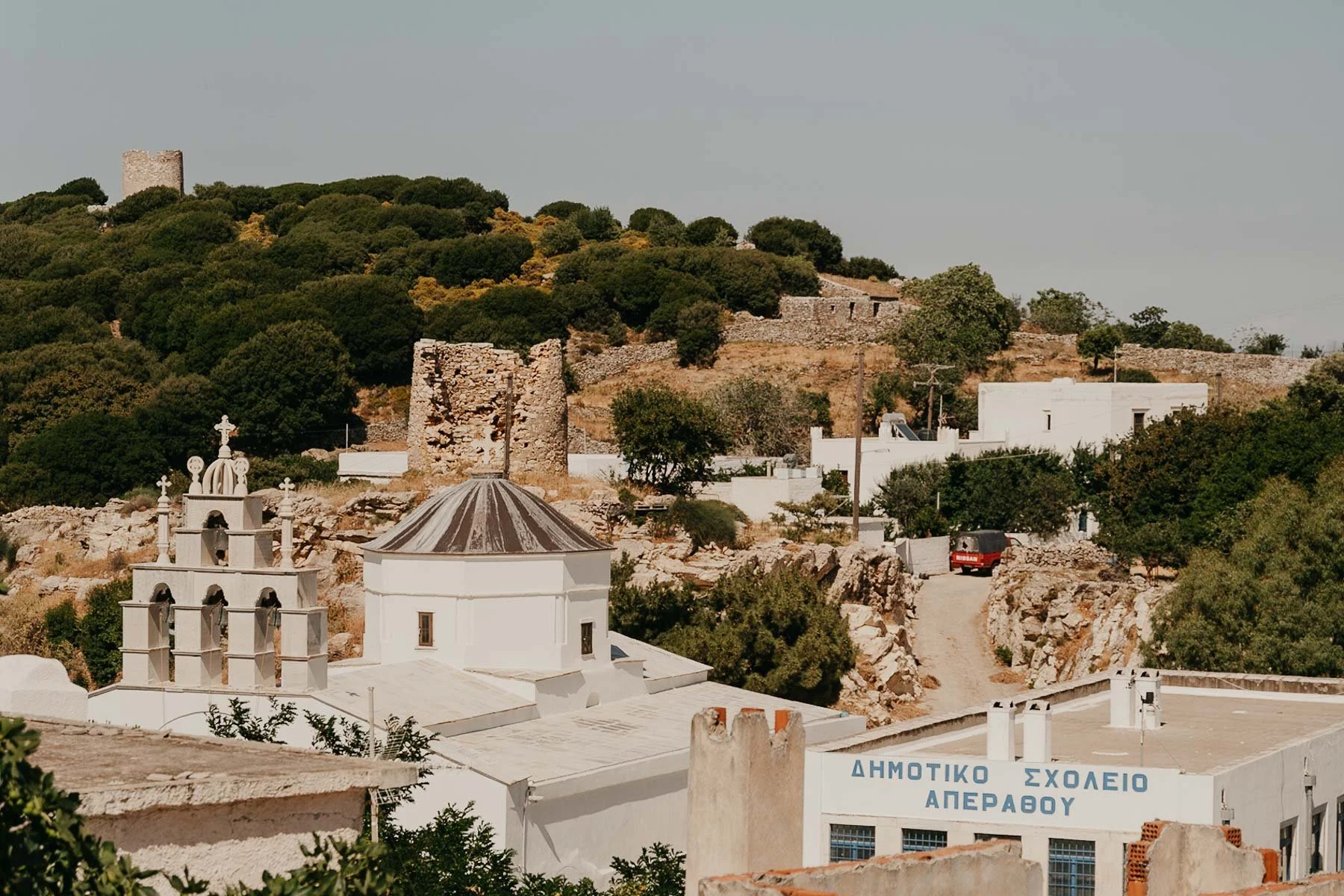
Apeiranthos is the most historical and distinctive village on Naxos - marble streets, Venetian towers, five museums and the best mountain taverna on the island. Here's our complete guide.
Most people come to Naxos for the beaches, but the famed marble village of Apeiranthos is as far from a beach as the island gets.
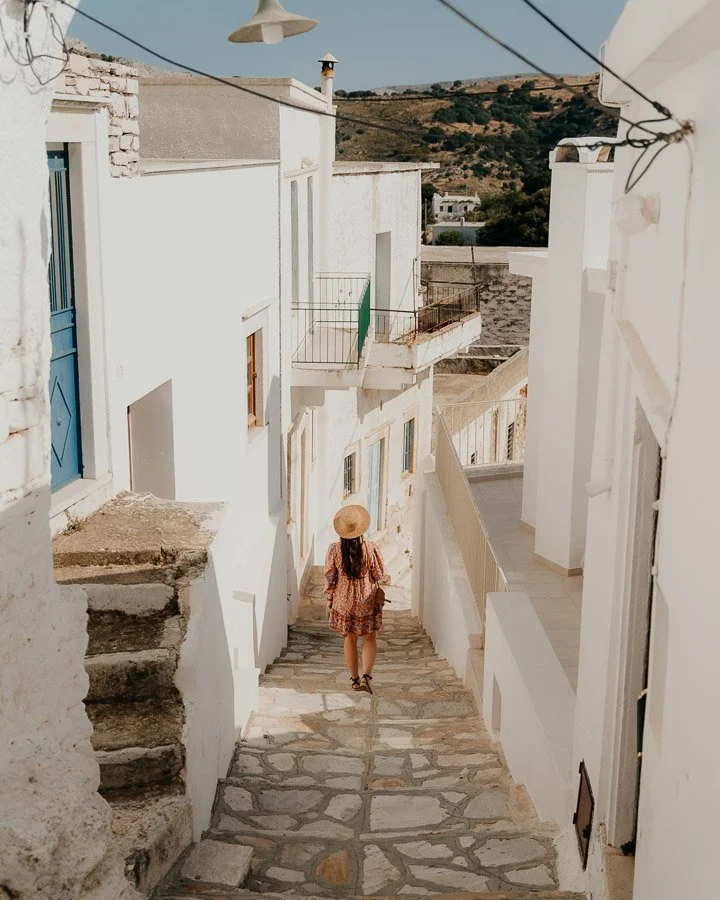
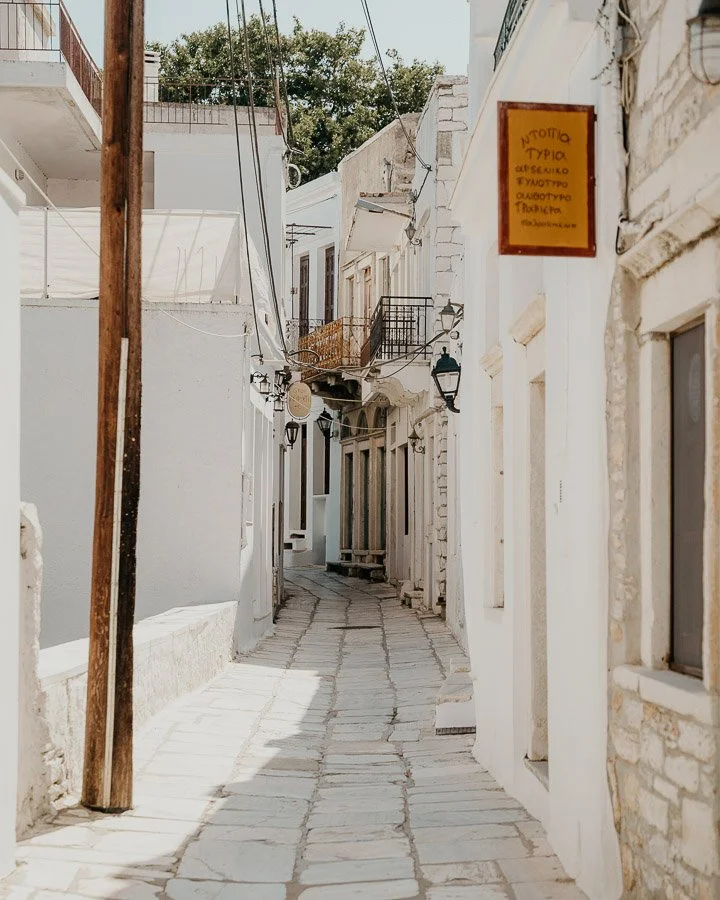
The ‘marble village’ moniker needs no explanation once you arrive. The streets are marble. The squares are marble. The arches, the staircases, the doorsteps: marble, all of it, polished smooth by centuries of footsteps. Even the souvenirs are marble.
The whole village seems to glow white in the morning sun, bouncing light around the laneways in a way that makes everything feel slightly luminous.
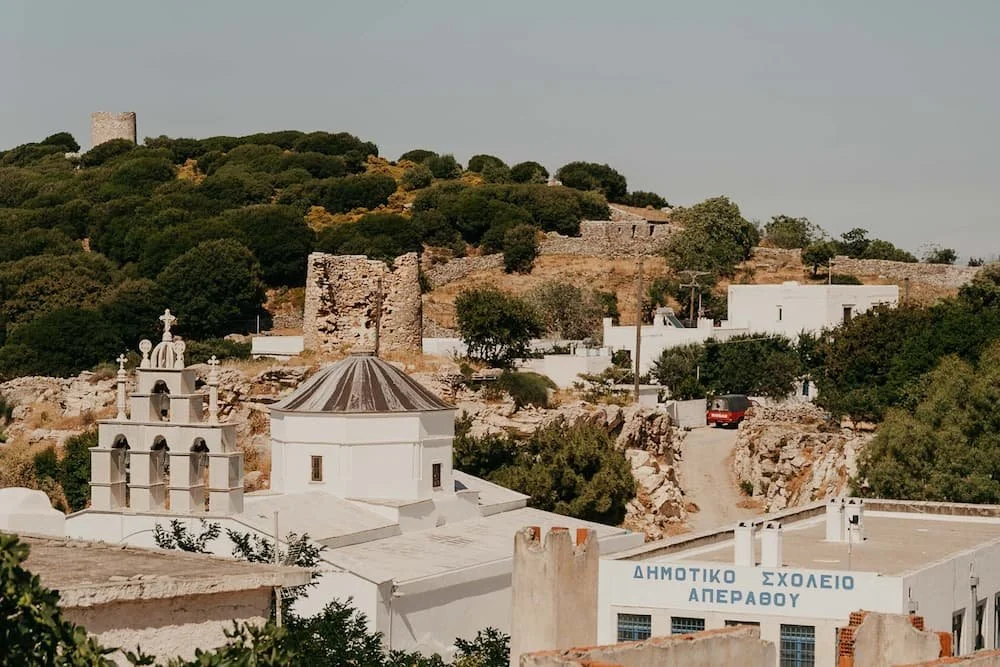
Built on the slopes of Mount Fanari, around 25km from Chora, Apeiranthos is the second largest village on Naxos and comfortably its most distinctive.
The village is believed to have been founded by Cretans around the 10th century, and a thousand years later, it still speaks its own dialect, laced with ancient Greek and Byzantine elements that linguists travel here specifically to study. The locals are Naxian, but they're Aperathian first, which is mind-boggling to think about.
We arrived at lunch, as part of our mountain villages road trip and spent hours walking every nook and cranny, which in Apeiranthos means a hell of a lot of stairs. We enjoyed a long lunch at Platanos Taverna on the main street (well, lane), looking back across the valley toward Mt Zas.
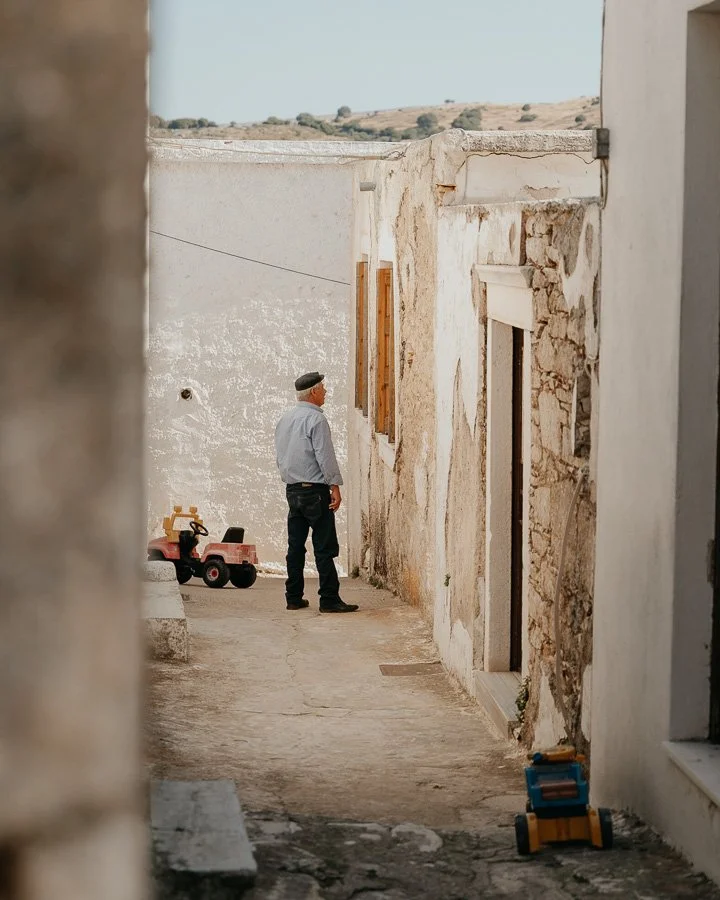
The village was sleepy in the best sense: cats asleep on marble steps, the odd voice drifting from a courtyard, yia yia in the kitchen, cooking lunch, history pressing in from every direction, and despite the stairs, we struggled to think of a better way to spend an afternoon on Naxos.
This is our guide to Apeiranthos: what to see, where to eat and how to make it part of a bigger Naxos mountain villages day.
LOVE OUR PHOTOS? Edit like us with our European Summers Preset Packs, and mobile video filters, inspired by the warm hues and vibes of summers spent in Europe
APEIRANTHOS AT A GLANCE
DON'T MISS | The Zevgoli Tower, wandering every marble laneway, lunch at Platanos Taverna with views back to Mt Zas, the Church of Panagia Aperathitissa, the combined museum ticket
BEST FOR | Those wanting to see a different side of Naxos - the mountain interior, the history, the food and the culture away from the beaches
WHEN TO VISIT | Morning or early afternoon - avoid the midday heat in July and August.
HOW LONG | Two to three hours for a proper wander. Longer if you want to relax over lunch at Platanos, which is easy to do.
GETTING THERE | By car: 30-40 minutes from Chora via Filoti. By bus: KTEL from Chora (€4.10, around 45 minutes) - check return times carefully.
WHERE TO EAT | Platanos Taverna (our pick), Stou Koútoupa, Aeriko Café
COMBINE WITH | Halki, Filoti, Koronas as a full mountain villages day
BOOK YOUR NAXOS TRIP
WHERE TO STAY |Ammothines Cycladic Suites (luxury) · Naxian Utopia (mid-range) · Katerina Roza Apartments (budget)
Full breakdown in our Where to Stay on Naxos guide
TOURS & EXPERIENCES | Download the GetYourGuide app to book sailing trips, cooking classes, and island tours, with 5% off your first app booking
FERRIES | Book your ferry to Naxos from Athens or the surrounding Cyclades through FerryHopper
CAR HIRE | Car hire is the easiest way to reach Naxos' quieter beaches, mountain villages and interior
GET CONNECTED | Set up an Airalo eSIM before you fly and have data ready to go when you arrive in Greece
TRAVEL INSURANCE | Get a quote from World Nomads, with cover available for 150+ activities
SPEND SMARTER IN GREECE | Get a Wise card to pay in Euros and skip foreign transaction fees
PLAN YOUR VISIT TO APEIRANTHOS
WHERE IS APEIRANTHOS?
Apeiranthos sits in the mountainous heart of Naxos, around 25km east of Chora on the slopes of Mount Fanari.
At roughly 650 metres elevation, it overlooks the island's fertile interior valleys with views stretching back toward Mt Zas to the south and, on clear days, the Aegean to the east.
HOW TO GET TO APEIRANTHOS
It's not a place you stumble across. Getting here requires driving inland and upward through the mountain villages, which is entirely the point.
The road from Chora via Filoti and Halki is one of the finest drives on the island, and Apeiranthos works best as the turning point of a full day in the interior rather than a standalone destination.
BY CAR
The most practical option by some margin. From Chora, follow the main inland road through Galanado, Damalas and Filoti, around 30-40 minutes depending on stops.
The road is well-maintained, and the drive through the mountain villages is genuinely beautiful. Parking is available at the lower and upper entrances to the village.
BOOK | Car rental in advance via Discover Cars
BY BUS
KTEL runs a daily service from Chora to Apeiranthos (€4.10, around 45 minutes). Check return times carefully before you go — the schedule is limited and missing the last bus is a genuine possibility.
A car is considerably more flexible for a proper exploration of the area.
HOW LONG TO SPEND IN APEIRANTHOS
Two to three hours is enough to walk the village properly, which would include every laneway, up to the towers, into the museums and back down to the platsa for lunch or coffee.
That said, you could probably do it a little quicker, especially if you're building it into a mountain road trip with stops at Halki, Filoti and Koronas, allow a full day for the whole loop.
Come in the morning or early afternoon.
By late afternoon, the village has wound down entirely, and the cafes start closing.
COMBINE APEIRANTHOS WITH A MOUNTAIN VILLAGES ROAD TRIP
Apeiranthos works best as part of a full day in the Naxos interior. The most satisfying loop from Chora:
Drive inland via Halki, the prettiest of the smaller mountain villages, then continue up to Apeiranthos for lunch at Platanos and an afternoon in the village.
From there, push further east through Koronas to Panermos on the remote southeastern coast for a late afternoon swim, or loop back via Filoti and Apeiranthos as your bookend.
Either way, the drive through the interior is as good as the destinations.
For the full breakdown of the road trip, our Things to Do on Naxos guide covers the whole interior route.
THINGS TO DO IN APEIRANTHOS
WANDER THE MARBLE LANEWAYS
The best thing to do in Apeiranthos is also the simplest: walk. Put the map away, pick a laneway and follow it upward.
Park at the lower entrance to the village and start from there. The tourist map in English and Greek at the lower entrance has a few marked walking routes and indicates the main landmarks, which is worth picking up before you head in.
From there, the only real direction is up, toward the towers and the platsa, though how circuitous you make that journey is entirely up to you.
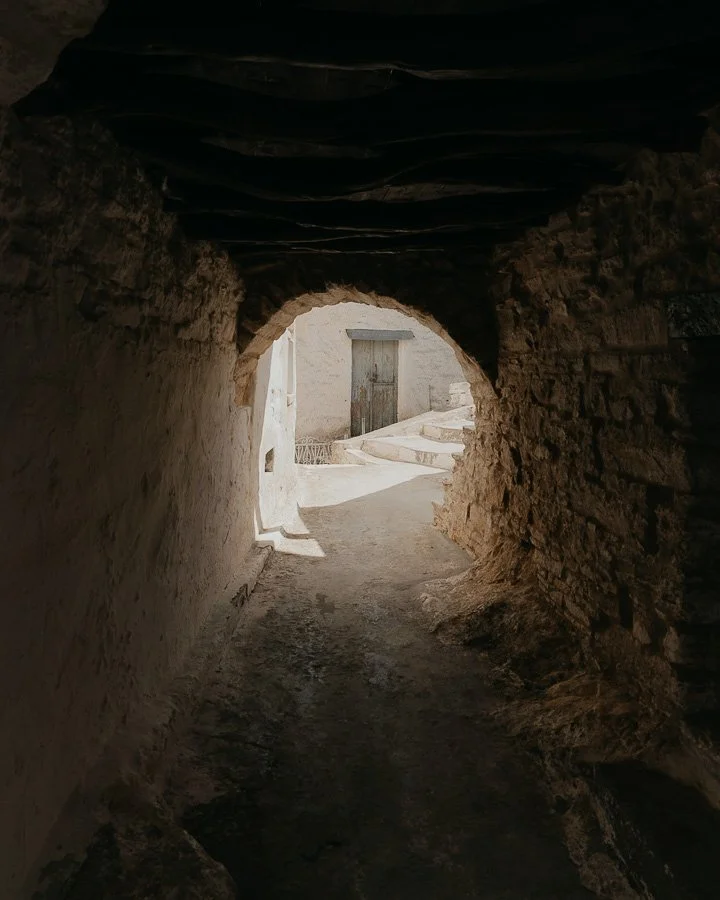
The marble is the thing that catches you first. Streets, squares, arches, staircases: all of it marble, polished smooth by centuries of footsteps, glowing bright white in the midday sun.
The further you get from the main street, the quieter it becomes - cats on doorsteps, the occasional sound of a radio from behind a closed shutter, a local walking back to their house for a siesta, which makes it all a little more magical.
A practical note: Apeiranthos means stairs. A lot of them. The village is built on a steep hillside and getting between its levels involves climbing, descending and climbing again. Fine for most visitors, worth knowing about for those with limited mobility or a pram in tow.
We arrived in the morning and had the village almost entirely to ourselves.
From what we understand, the window between 10 am and 3 pm brings tour groups and day trippers through on the main street, which narrows the experience considerably. Go early if you can, or time your arrival for after lunch when the groups have moved on.
Leave the phone in your pocket for at least part of it. Getting a little lost is the whole point.
THE ZEVGOLI TOWER
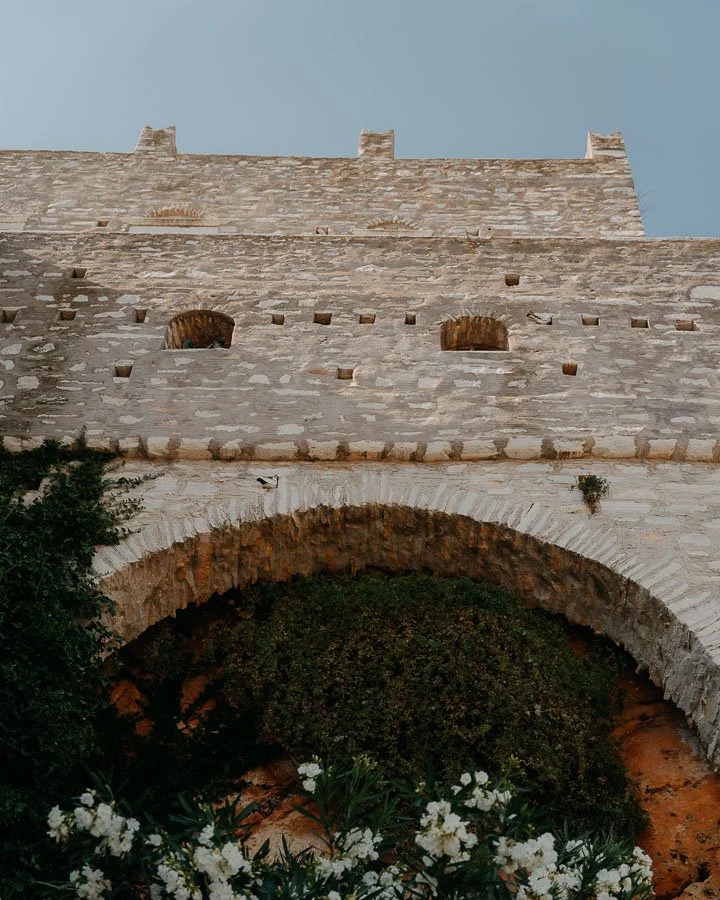
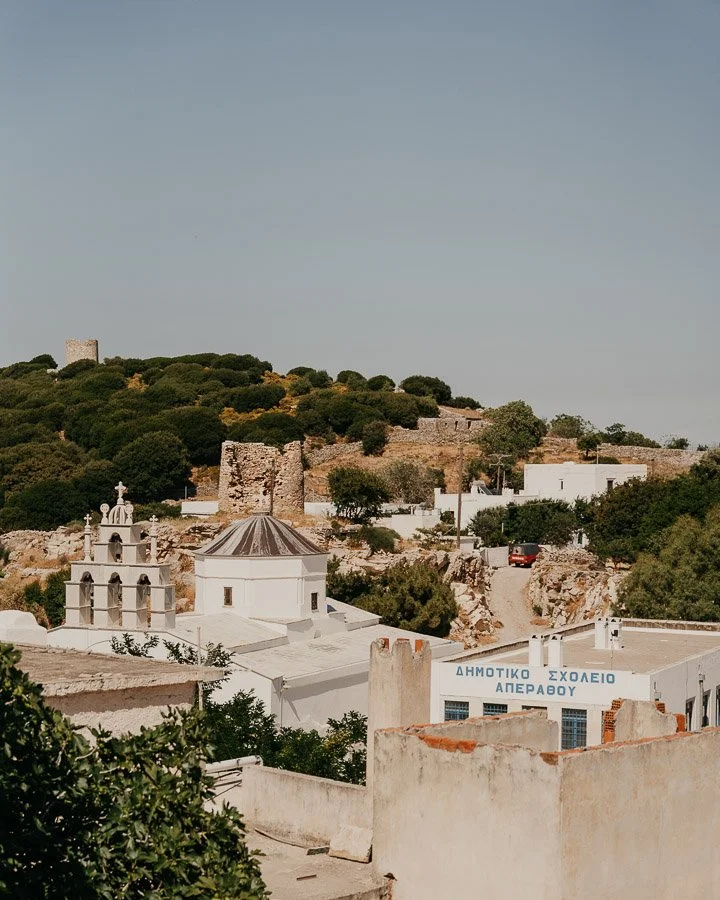
The first thing you see arriving in Apeiranthos, and impossible to miss: a 17th-century Venetian tower built directly on a rock at the village entrance, looking from certain angles as if it's floating above the street below.
Built by the Castri family during the Venetian period — their coat of arms is still carved above the main entrance — the tower changed hands over the centuries before being acquired by the Zevgoli family after Greek independence.
It has since been renovated and functions as a private residence, mostly during the summer. When the owners are present, they allow access to the tower.
The Tower of Bardani, further into the village, is worth finding too - it’s smaller than Zevgoli but equally well-preserved, and considerably less visited.
THE MUSEUMS
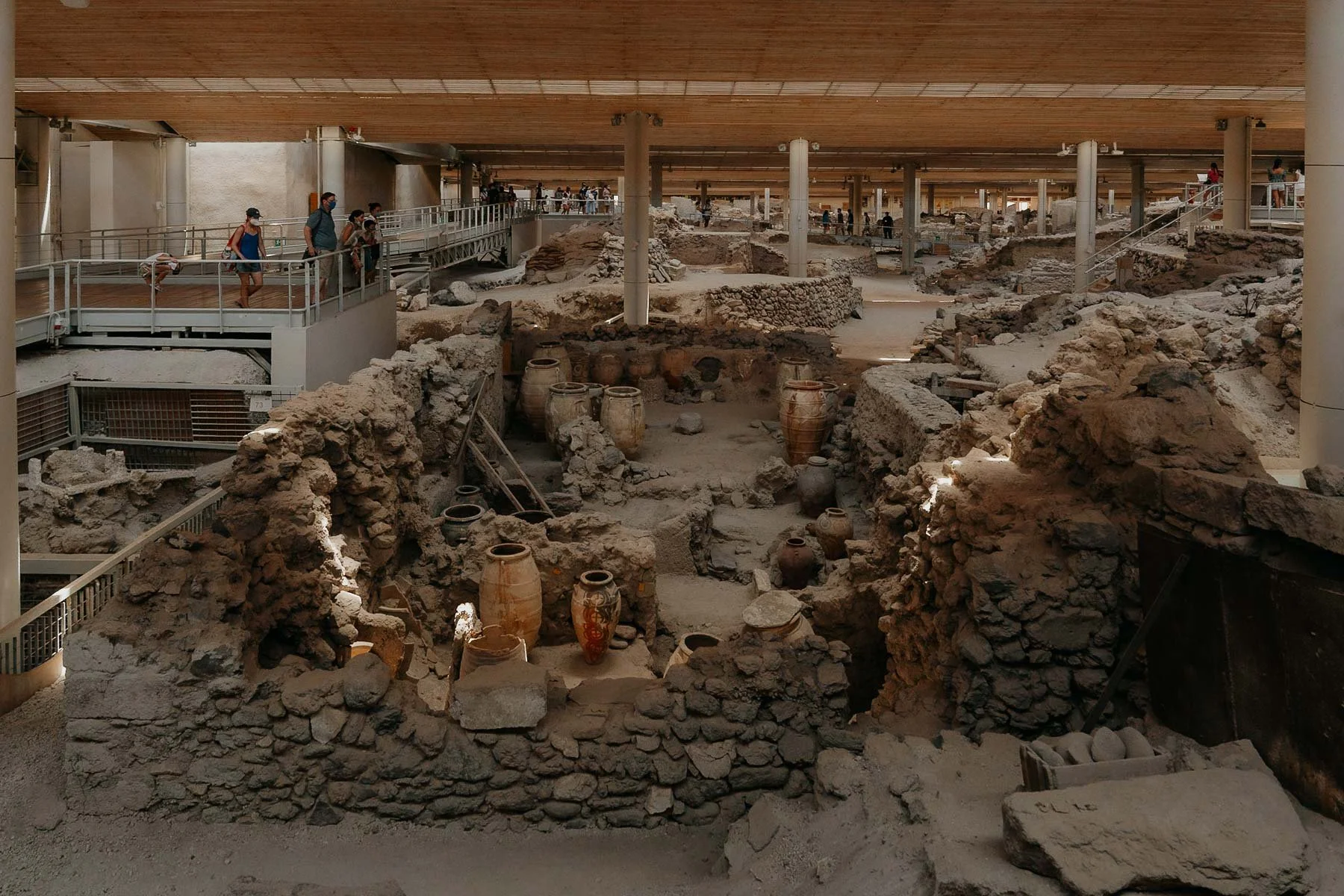
Apeiranthos has five museums for a village of around 500 people, which tells you something about how seriously this place takes its own history.
A single ticket covers entry to four of them, and they're all concentrated along the main street, making it easy to work through them without much planning.
ARCHAEOLOGICAL MUSEUM | over 2,000 exhibits covering the prehistoric and classical history of the Apeiranthos area. The Cycladic figurines are the highlight.
GEOLOGICAL MUSEUM | Apeiranthos sits on some of the most geologically interesting terrain in the Aegean, and this small museum covers the island's volcanic and mineral history, including its once-significant emery mining industry.
Emery from this area was used across Europe for centuries to polish metals and grind millstones.
FOLKLORE MUSEUM | traditional tools, costumes, household objects and embroideries from the village's past. The women's embroidery cooperative that still operates in the village grew directly from this tradition.
NATURAL HISTORY MUSEUM | flora and fauna of Naxos, with a focus on the mountain environment of the interior.
CHURCH OF PANAGIA APERATHITISSA
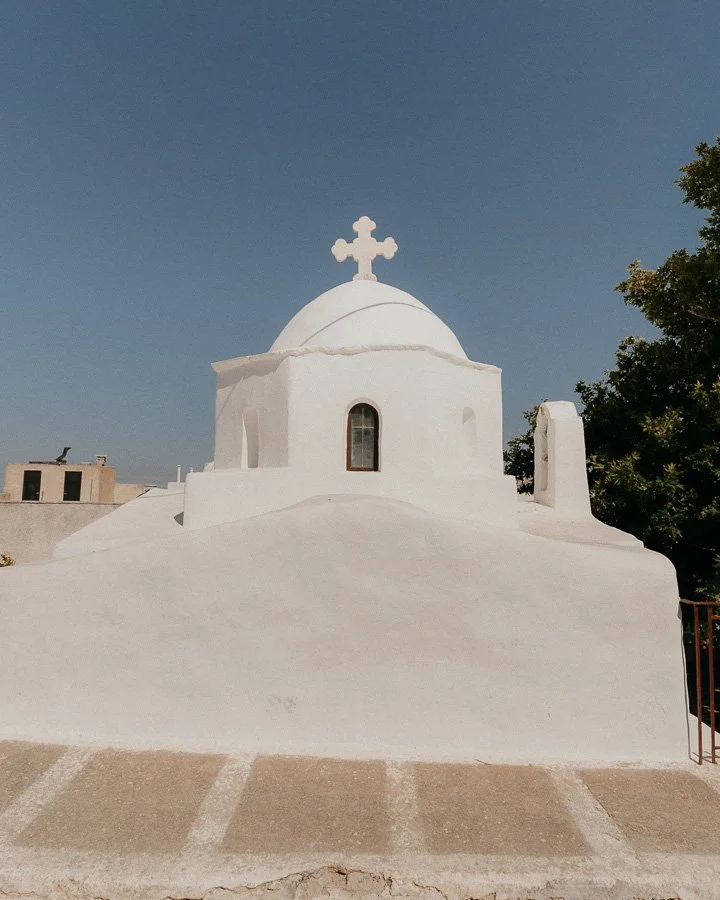
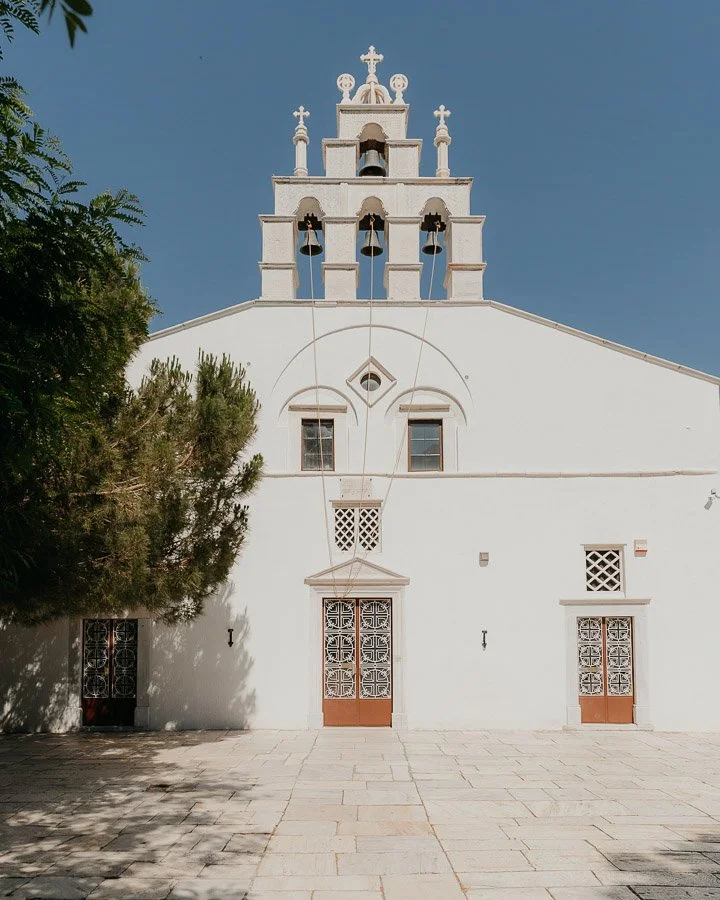
At the lower entrance to the village stands the Church of Panagia Aperathitissa, built in 1819 with a triple bell tower of white marble that sets the tone for everything that follows.
The story goes that an icon of the Virgin Mary, found by a shepherd, indicated the exact location where the church should be built.
We stepped inside briefly during our visit, and after the brightness of the marble streets outside, the cool, dark interior took a moment to adjust to.
However, once the gilded iconostasis came into focus, the whole thing was worth the pause - it’s quiet and unhurried, as you’d expect.
THE PLATSA AND THE MAIN SQUARE
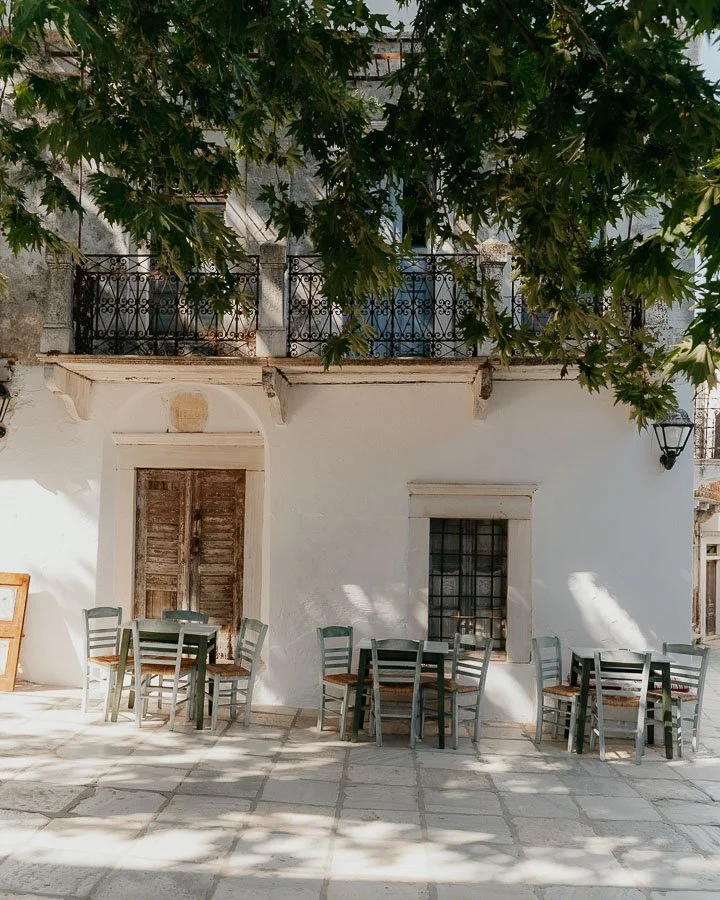
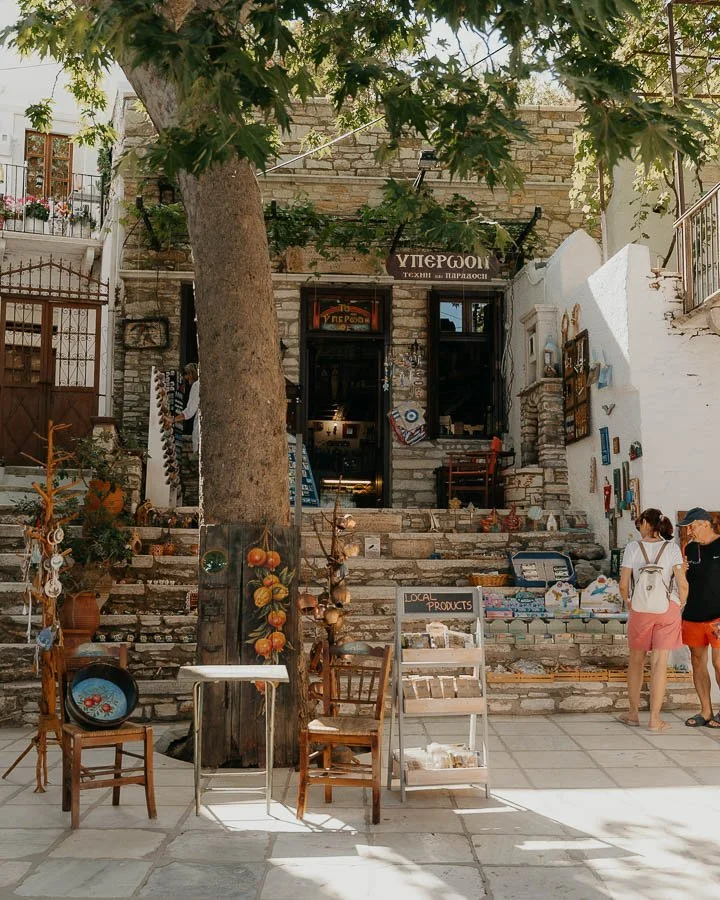
The platsa is the social heart of Apeiranthos - a small central square shaded by a large plane tree, surrounded by cafes and a handful of shops.
This is where the village comes to sit, drink coffee and watch the afternoon pass, so we suggest joining in.
Pull up a chair, order a Greek coffee and stay for a while. There's an unhurried quality to the platsa that the rest of the village filters into, and it's the place to escape the heat and decompress, post stair climbing.
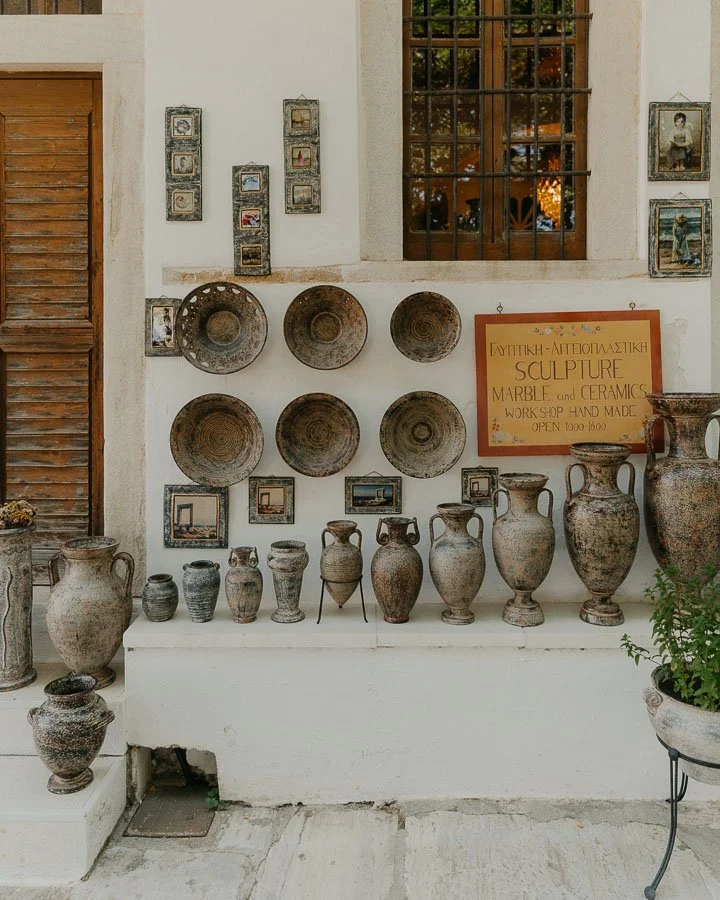
The main street running through the village is also where restaurants and souvenir shops are concentrated, featuring embroideries from the Women's Woven Products Cooperative, local produce, and traditional crafts.
The embroideries in particular are the real thing: made by hand in the village and sold directly, without the tourist markup you'd find on the coast.
WHERE TO EAT IN APEIRANTHOS
The main street through the village has a handful of tavernas and cafes, all doing honest Naxian food at prices that feel reasonable compared to the coast.
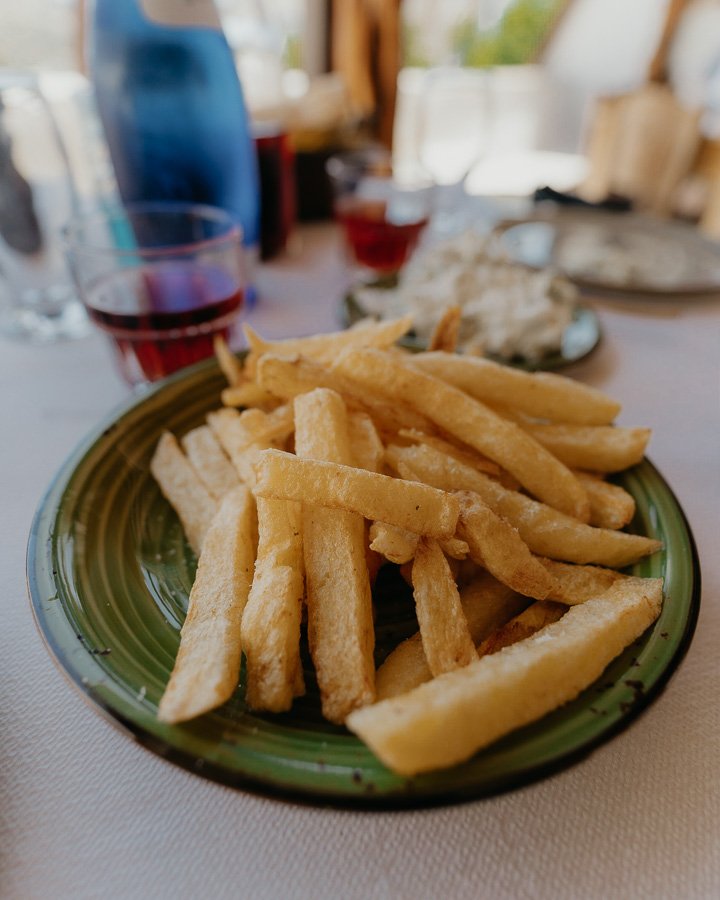
This is mountain village cooking, so expect meat & potatoes from the surrounding farms, local cheeses, bulk wine from the village, and it's some of the best food on the island.
PLATANOS TAVERNA
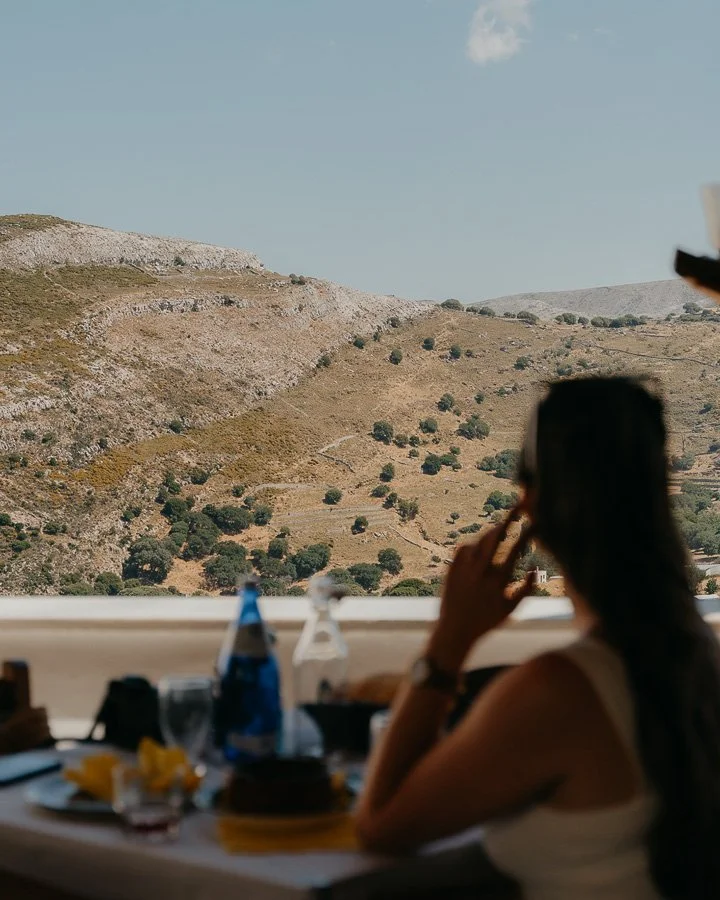
Where we ate, and where we'd eat again. Sitting since 1982 under the shade of the plane tree beside the Zevgoli Tower, with views back across the valley toward Mt Zas.
The rosto pork is the thing to order - a traditional Apeiranthos recipe, slow-cooked and served with spaghetti, made from their own production. The goat with spaghetti is equally good.
Local cheeses, bulk village wine, and a terrace that overlooks Mt. Zas made this one of the better meals we had in a month on Naxos.
STOU KOÚTOUPA
A newer addition with a perfect rating from everyone who's found it.
Traditional Greek cooking, a local crowd, the kind of place that doesn't need to try hard because everything is already good. Worth seeking out if Platanos is full or closed.
AERIKO CAFÉ
Coffee, drinks and a straightforward pizza menu. The right place to sit on the platsa and watch the village go about its afternoon before heading back to the coast.
TRAVEL INSURANCE | STAY SAFE IN GREECE
Honest take: if something goes wrong, a medical emergency, a missed ferry, a scooter accident on a coastal road, travel insurance is the difference between a stressful story and a catastrophic one.
After 10+ years of full-time travel, here's what we use:
WORLD NOMADS | Offers travel insurance for independent travellers and intrepid families. Their policies offer coverage for more than 150 activities as well as emergency medical, lost luggage, trip cancellation and more.
GET A QUOTE | World Nomads
PLANNING A TRIP TO GREECE SOON?
Make the most of your time on Naxos with our essential Greece travel guides.
EXPLORE NAXOS
WHERE TO STAY ON NAXOS
Where to Stay on Naxos Island - hotels, villas and apartments across every budget and neighbourhood
MORE CYCLADES
PLAN YOUR TRIP TO GREECE WITH THESE POSTS!




Some of the links on this post are affiliate links.
If you choose to purchase using these links, we receive a small commission at no extra cost to you. Please know that by using these affiliate links, you're directly supporting The Common Wanderer to stay wandering, the running costs of the site, and our ability to provide you with free content to help you on your travels.
That, and you're officially a legend.

From what to see and do, through to the best restaurants and bars to enjoy your evenings, our Naoussa guide has everything you’re looking for.