
A Guide to Visiting Akrotiri, Santorini’s Ancient City
Planning to visit Akrotiri in Santorini? Our guide covers tickets, opening hours, how to get there, what to see, whether you need a guide, and why this Bronze Age city is worth your time.
Long before Santorini became shorthand for caldera sunsets, cave suites and linen-clad photo shoots, there was Akrotiri.
Set near the island’s southern coast, this Bronze Age city was once one of the most important settlements in the Aegean, a prosperous trading town with multi-storey buildings, drainage systems, pottery workshops, frescoed rooms and streets.
Then the volcano came.
Around 3,600 years ago, the eruption of Thera buried Akrotiri beneath ash and volcanic debris, preserving parts of the city in a way that has often earned it the nickname “the Minoan Pompeii”.
The comparison is useful, but they’re not the same. Akrotiri is older, quieter and less theatrically preserved than Pompeii. There are no plaster casts of bodies, no grand villas frozen in time, and many of its most important frescoes and objects now live in museums.
What remains is simpler: streets, staircases, storage jars, building foundations, drainage channels and the outline of a city that existed long before Santorini became Santorini.
Some have linked Akrotiri to Plato’s story of Atlantis, suggesting the Thera eruption may have helped inspire the myth of a lost civilisation swallowed by the sea. There’s little hard evidence to prove that theory, but the site doesn’t need it - Akrotiri is fascinating enough.
We visited in a bit of a rush, squeezed into a busy Santorini itinerary, and our honest advice is this: go, but don’t go without a plan. Without context, the enclosed ruins can feel a little abstract.
With a good guide, or even a little reading beforehand, Akrotiri becomes one of the most compelling things to do on Santorini, and a rare chance to see the island before the sunsets, cruise ships and infinity pools.
Here’s everything you need to know before visiting Akrotiri in 2026, including tickets, opening hours, how to get there, what to see, whether you need a guide, and how to pair it with Red Beach, Megalochori or the Museum of Prehistoric Thera.
LOVE OUR PHOTOS? Edit like us with our European Summers Preset Packs, and mobile video filters, inspired by the warm hues and vibes of summers spent in Europe
AKROTIRI AT A GLANCE
LOCATION | Southern Santorini, near Akrotiri village and Red Beach
BEST FOR | Ancient history, archaeology, culture
OPENING HOURS | Generally 8:00 am to 8:00 pm
TICKETS | €20 full entry, €10 reduced entry
HOW LONG TO VISIT | Around 60–90 minutes
GUIDED TOUR | Yes - book here
BEST TIME TO VISIT | Morning or late afternoon, especially in summer
GOOD TO KNOW | The site is covered and protected, but it’s not air-conditioned in the way a museum is, so summer visits can still feel warm
PLAN YOUR AKROTIRI VISIT
IS AKROTIRI WORTH VISITING?
If you’re interested in ancient history, archaeology, volcanic landscapes, or seeing a side of Santorini that has nothing to do with sunset bars, then Akrotiri is worth a visit.
However, it’s worth tempering your expectations somewhat, as it is not as visually dramatic as Pompeii, and if you arrive expecting a perfectly preserved ancient city, you may be underwhelmed.
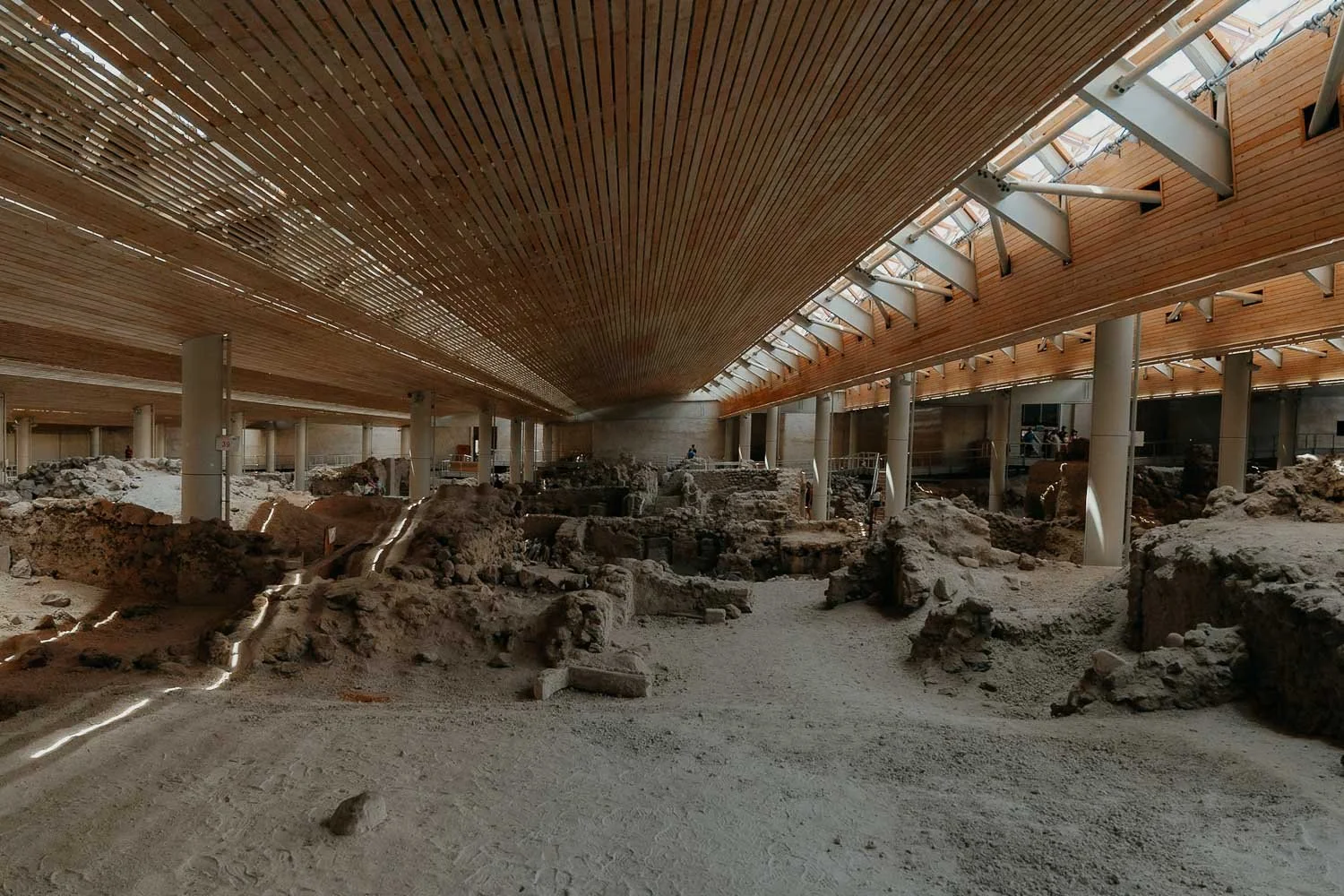
Much of what you’ll see is structural: streets, walls, staircases, storage vessels and building remains, all protected beneath a large roof.
But that’s also what makes Akrotiri interesting. It was a real Bronze Age city, with homes, workshops, drainage systems, imported goods, painted rooms and the everyday objects of people who lived here thousands of years ago, and that’s pretty cool to witness.
One thing we highly recommend, though, is to visit with a guide, or if you pair it with the Museum of Prehistoric Thera in Fira, where many of the site’s most important finds are displayed.
WHERE IS AKROTIRI AND HOW TO GET THERE
The Akrotiri Archaeological Site is located in southern Santorini, close to the modern village of Akrotiri and near Red Beach.
It’s around 12 kilometres from Fira, 9 kilometres from Megalochori, and 22 kilometres from Oia, making it easiest to visit as part of a half-day exploring the island’s south.
Red Beach, Akrotiri village, the Akrotiri Lighthouse, Vlychada Beach and Megalochori all pair well with a visit.
The easiest way to get to Akrotiri is by rental car, ATV or scooter, especially if you want to combine the ruins with Red Beach, Akrotiri Lighthouse, Vlychada or Megalochori.
From Fira, the drive takes around 20 minutes. From Oia, allow around 40–45 minutes, depending on traffic. Parking is available near the archaeological site, though it can get busy in peak summer.
You can also reach Akrotiri by local KTEL bus from Fira. Buses run towards Akrotiri and Red Beach, and the site is a short walk from the stop or car park. This is the cheapest option, but check current timetables before travelling, especially outside summer.
If you’re short on time, a guided tour or private driver can make sense, particularly if you want to visit Akrotiri, Red Beach, the lighthouse and a winery in one loop (see below).
AKROTIRI TICKETS AND OPENING HOURS
Akrotiri Archaeological Site usually operates with longer opening hours in summer and shorter hours in winter. In summer, opening hours are generally 8:00 am to 8:00 pm, with reduced hours on selected days. In winter, hours are shorter, and the site may close one day a week.
Full entry is €20, with reduced tickets available for eligible visitors.
As with all archaeological sites in Greece, opening hours and ticket conditions can change seasonally, so check the official Hellenic Heritage e-ticket platform or the Greek Ministry of Culture before visiting.
BOOK | Book Akrotiri entry tickets in advance
DO YOU NEED A GUIDE FOR AKROTIRI?
You don’t need a guide to visit Akrotiri, but we’d strongly recommend one.
The site is easy to walk around independently, but it doesn’t always explain itself. Many of the most important objects and frescoes have been moved to museums, and what remains on site can feel abstract unless you understand what you’re looking at.
We visited Akrotiri in a hurry, squeezed into an already packed Santorini day, and in hindsight, we wish we’d allowed more time and joined a guided tour.
A good licensed guide can explain the city’s layout, the eruption, the missing residents, the frescoes, the trade links and why Akrotiri matters far beyond Santorini.
If you’re already making the effort to visit, it’s worth doing properly.
HOW LONG SHOULD YOU SPEND AT AKROTIRI?
We recommend allowing 60 to 90 minutes to visit Akrotiri.
If you’re visiting independently and mainly want to walk the site, an hour is usually enough. If you’re joining a guided tour, reading the information panels, or visiting with a deeper interest in archaeology, allow closer to 90 minutes.
We’d also recommend pairing Akrotiri with the Museum of Prehistoric Thera in Fira if you want the site to properly make sense. Akrotiri shows you the city; the museum shows you more of what was found inside it.
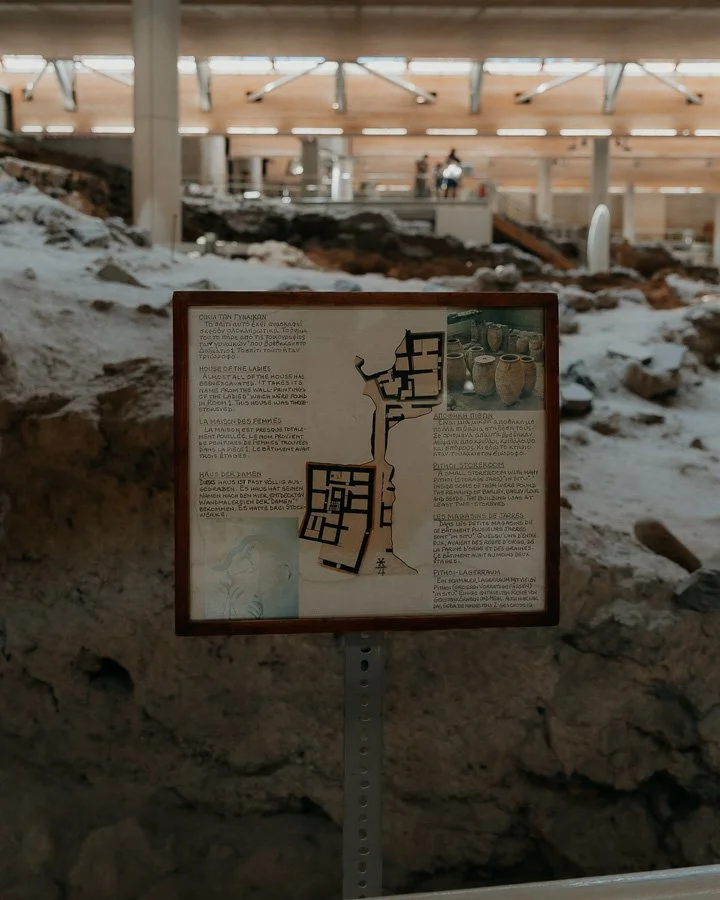
A SHORT HISTORY OF AKROTIRI
Akrotiri was a Bronze Age settlement on ancient Thera, the island we now know as Santorini. Its position in the Aegean made it an important trading centre, connected with Crete, the Cyclades and the wider eastern Mediterranean.
By the second millennium BCE, Akrotiri had grown into a sophisticated town. Excavations have revealed multi-storey buildings, paved streets, drainage systems, pottery, storage vessels, furniture impressions and frescoes that suggest a wealthy, connected and highly organised society.
Then came the eruption of Thera, one of the most powerful volcanic events in ancient history. Akrotiri was buried beneath ash and volcanic material, preserving parts of the city for thousands of years.
The site was rediscovered in the 19th century, but major excavations began in 1967 under archaeologist Spyridon Marinatos. Since then, Akrotiri has become one of the most important prehistoric sites in the Aegean, and one of the best places to understand Santorini before the island became a travel fantasy.
WHAT HAPPENED TO THE PEOPLE OF AKROTIRI?
One of the strangest things about Akrotiri is what archaeologists didn’t find.
Unlike Pompeii, no human remains have been discovered at the site. For a long time, this supported the idea that Akrotiri’s residents had a warning. Earthquakes may have shaken the island before the eruption, giving people time to gather valuables, leave the city and escape by sea.
But the story may be more complicated. Evidence of repair work in some buildings suggests that at least some residents may have returned after earlier earthquake damage, perhaps trying to rebuild their homes and continue life as normal before the final eruption came.
That uncertainty is part of what makes Akrotiri so compelling.
WHAT TO EXPECT AT AKROTIRI
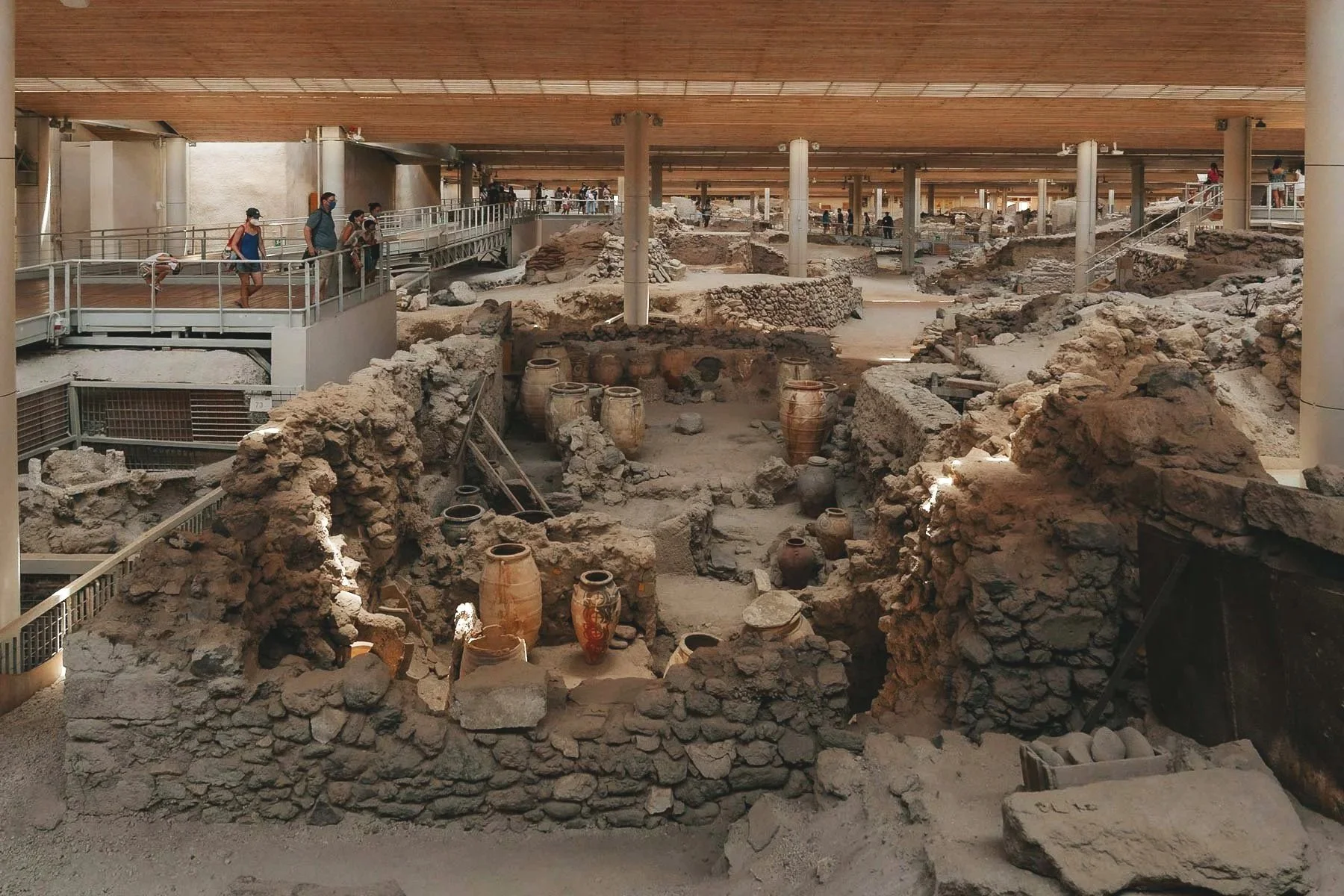
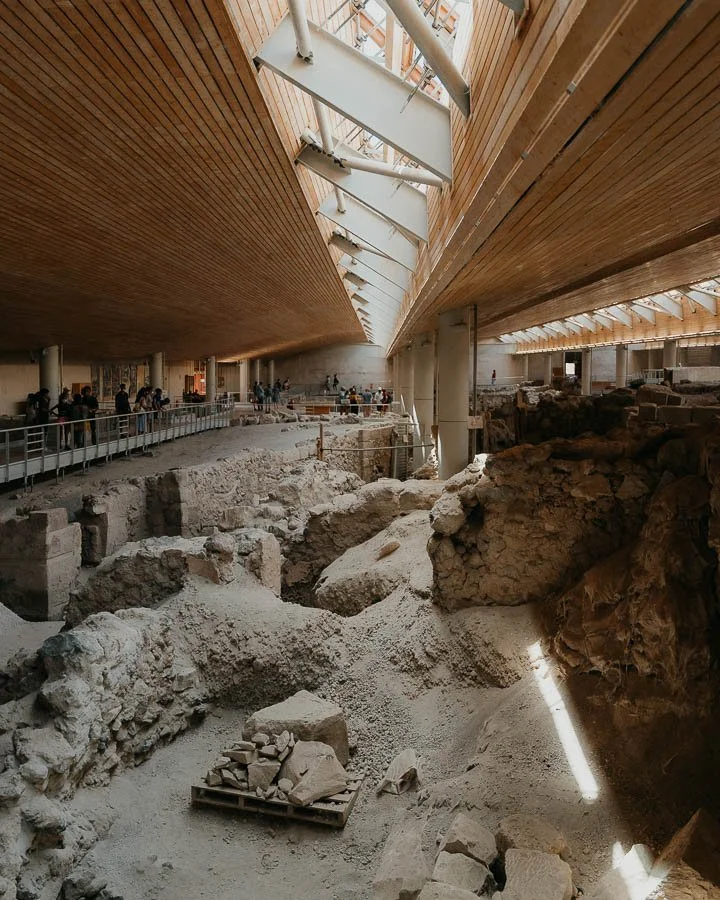
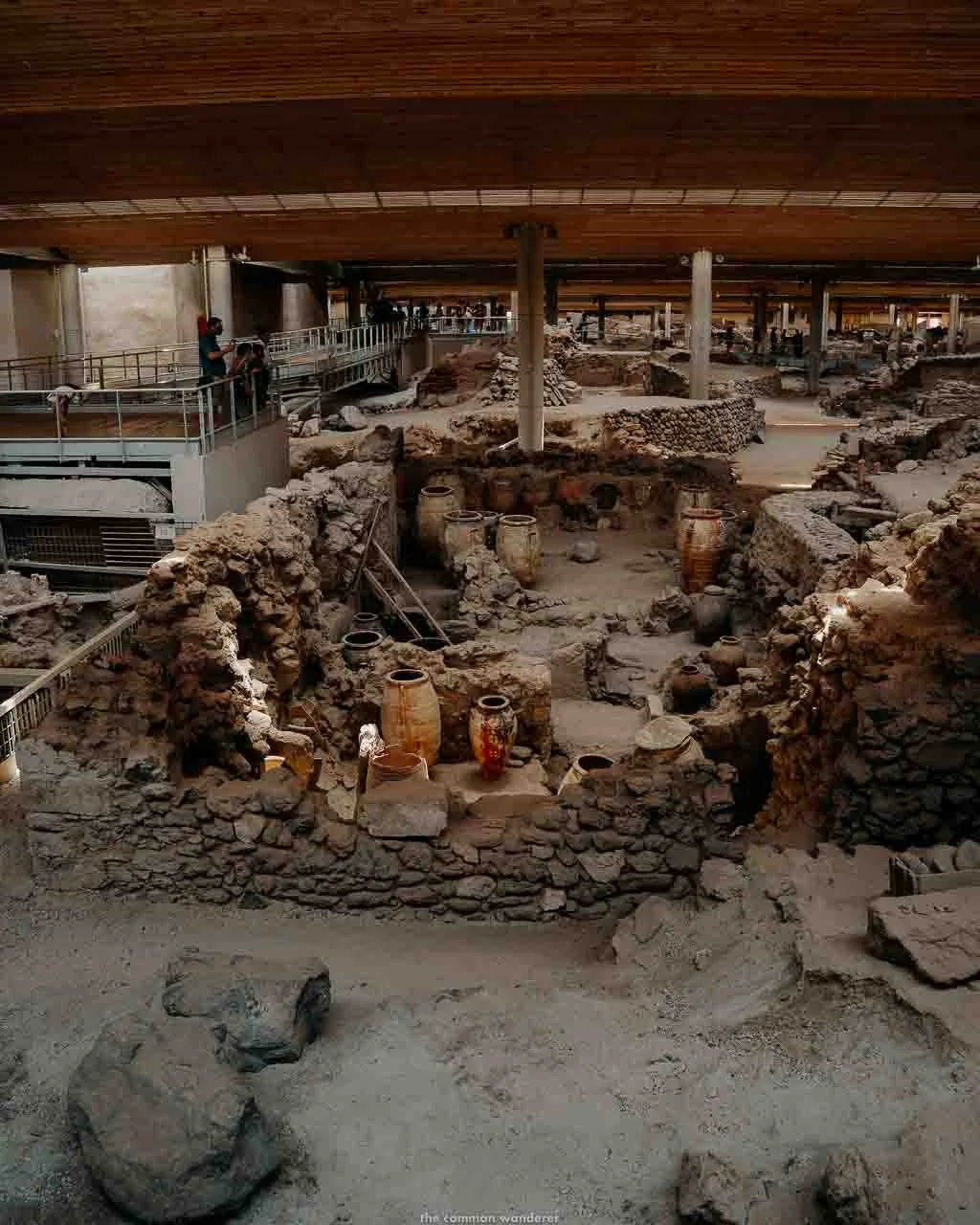
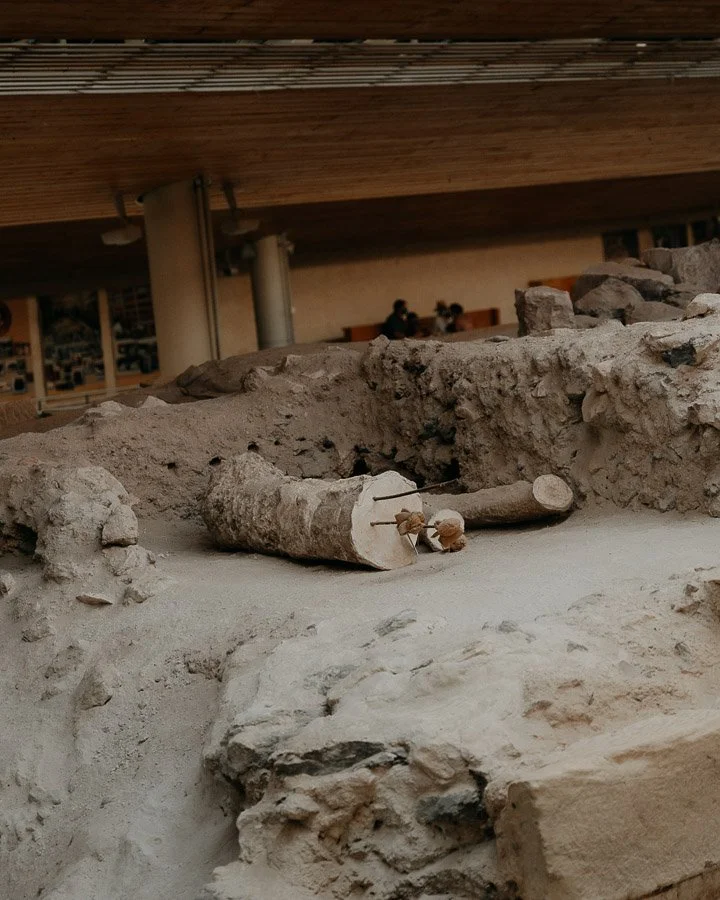
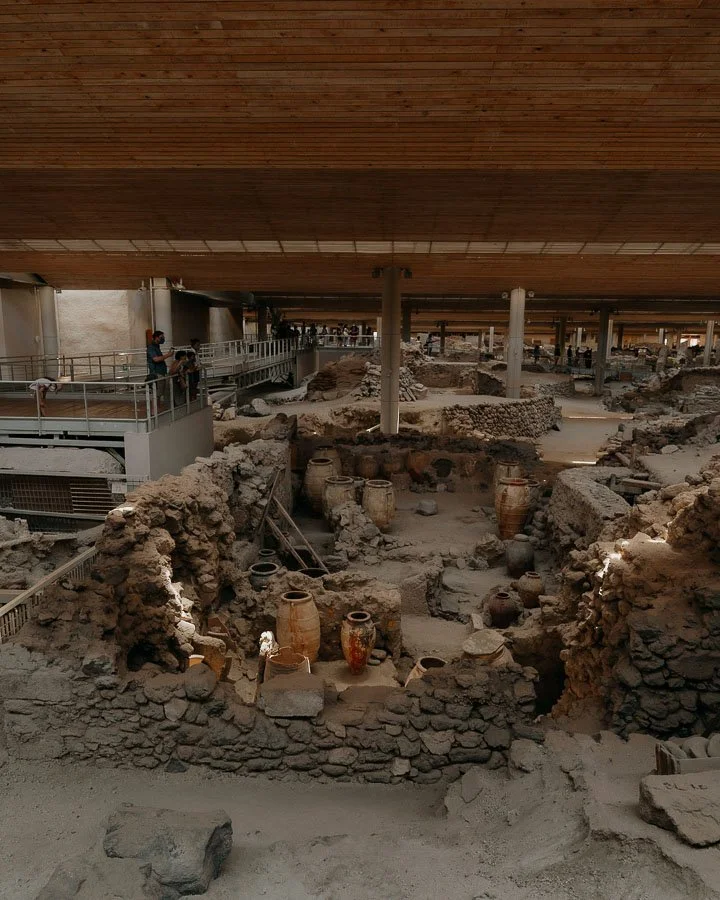
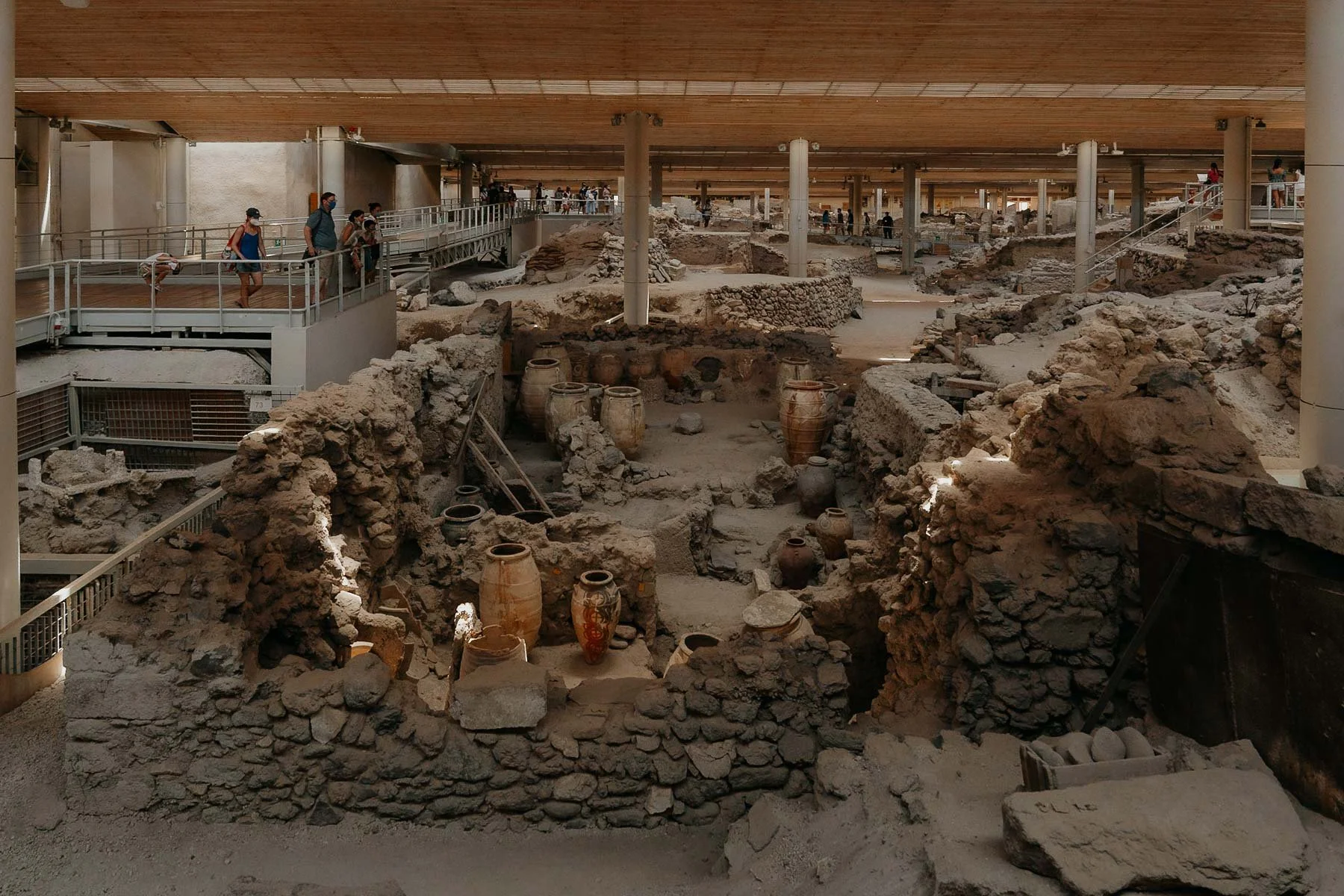
Akrotiri is not an open-air ruin like Pompeii, and the archaeological site is covered by a large protective roof, with walkways leading you above and through sections of the ancient city.
At first glance, it can feel a little underwhelming: a vast enclosed structure, fragments of buildings, old streets, walls, staircases and a lot of clay storage jars. But look more closely, and the details start to become apparent, and this is where the beauty of the site exists.
You’ll see the outline of homes, drainage channels, pottery, storage rooms, streets and the remains of a city that was far more sophisticated than most people expect from the Bronze Age.
This is also why we think a guide helps so much.
WHAT TO SEE AT AKROTIRI
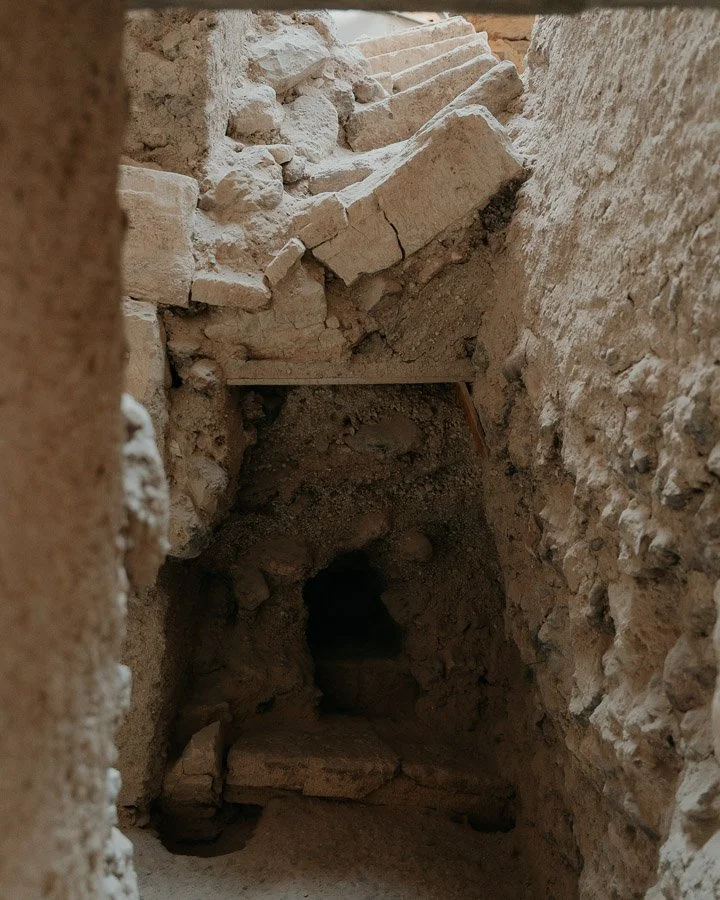
The walkways you walk along inside are suspended well above the ruins, and what feels like ground level to you is actually rooftop height in ancient Akrotiri. The original streets are far below, buried under up to 40 metres of volcanic ash that had to be painstakingly removed before any of the site was visible at all.
Looking down from those walkways, the scale of what remains starts to sink in. This was not a scattered village, but a town filled with lanes, buildings, storage spaces and public areas.
Some of the buildings once rose two or three storeys, while some of the walkways descend into the reconstructed interiors at street level, where details like an original Minoan toilet and a stone bathtub aren’t dissimilar to a normal family home.
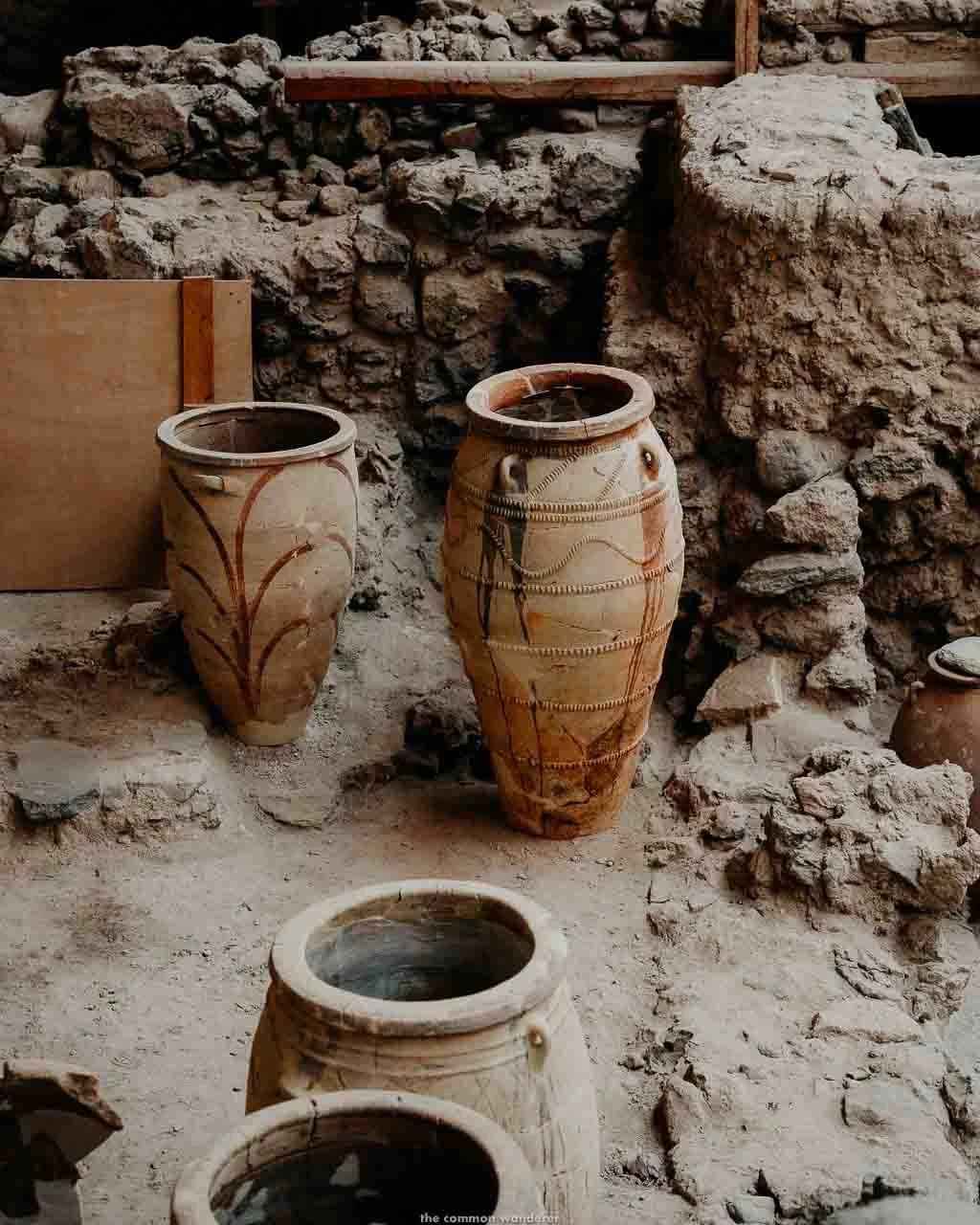
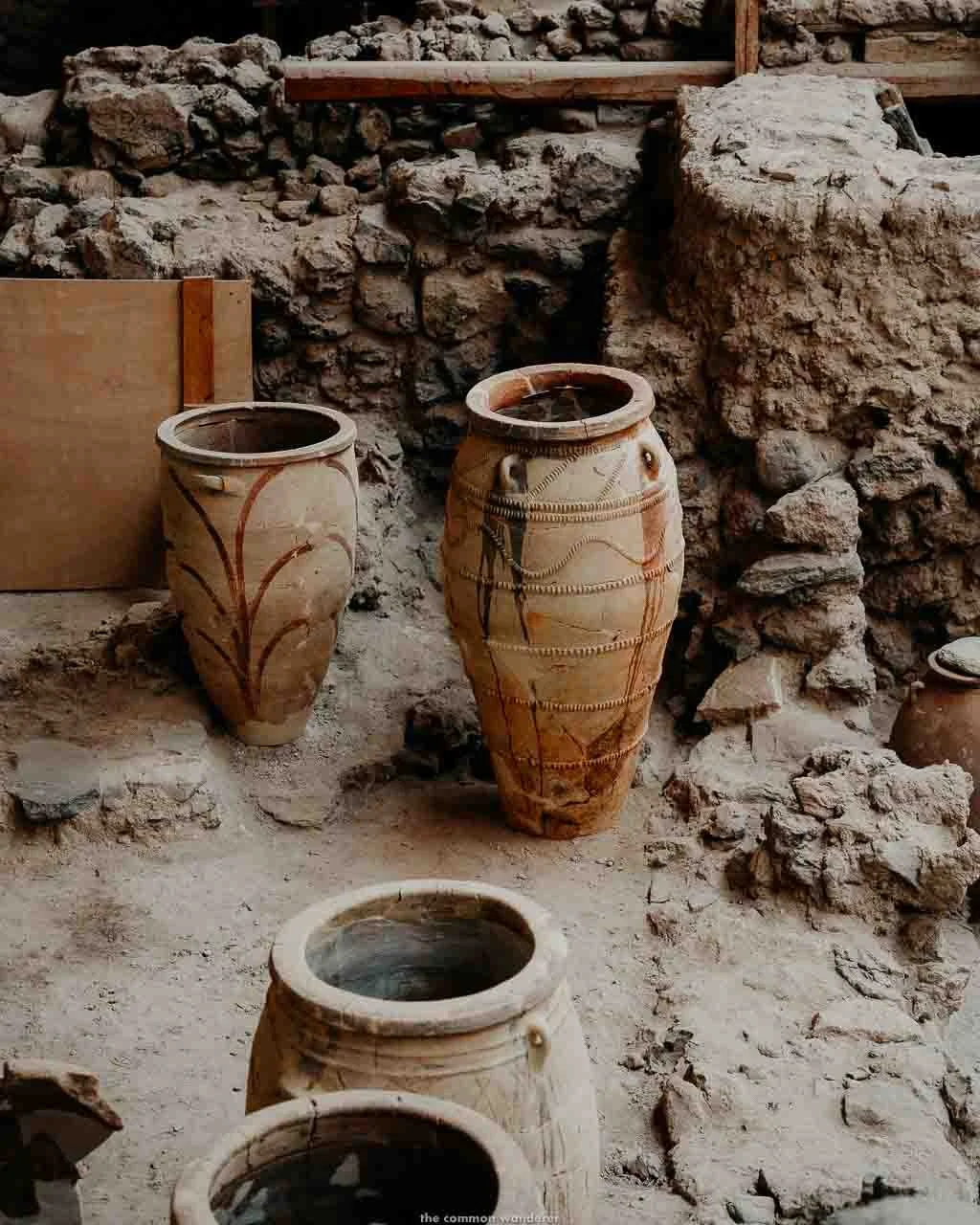
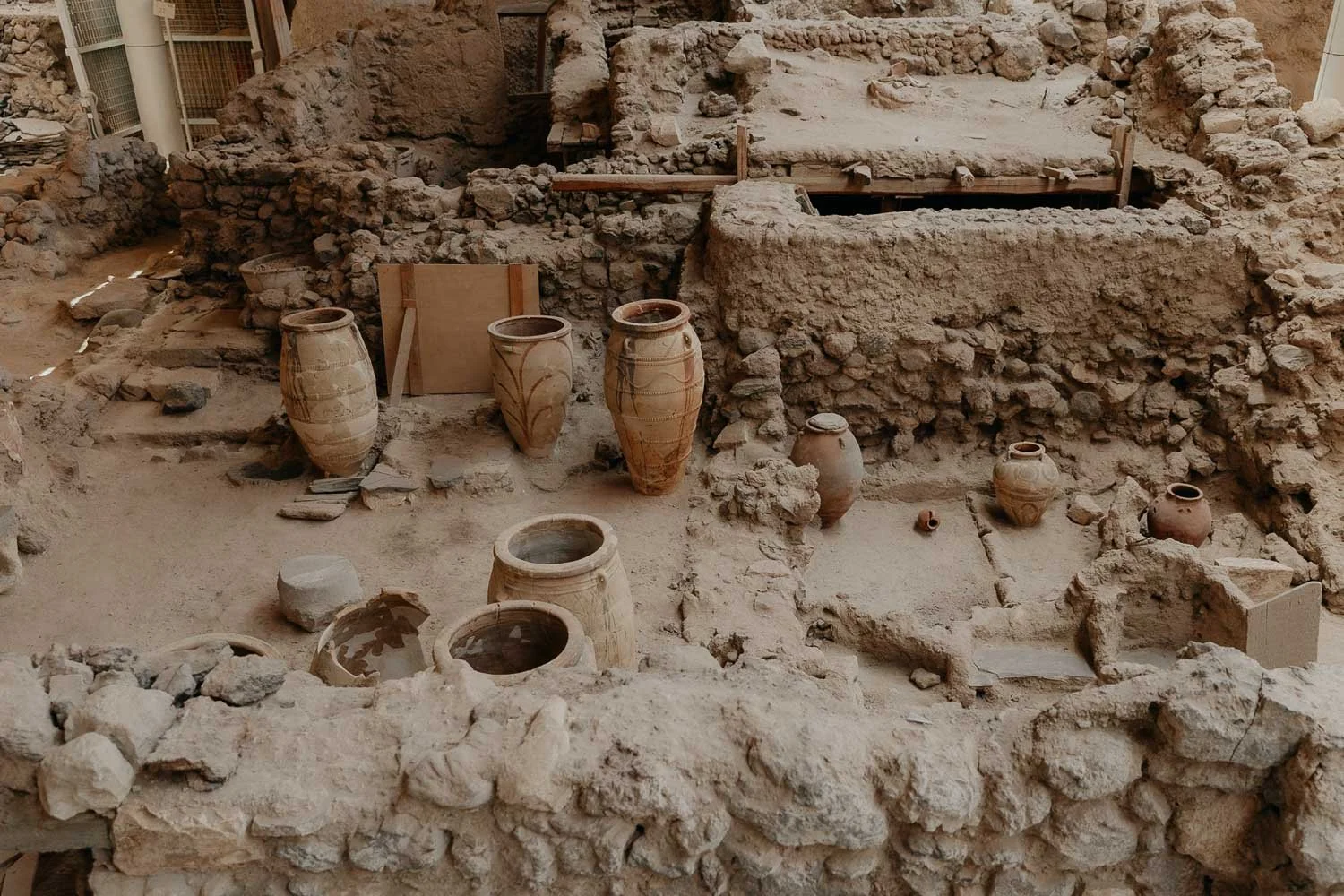
The pithoi are everywhere throughout the site. These are the large clay storage jars used for wine, oil and grain, some of them found with the remains of olive oil or fish still inside after three and a half thousand years, which makes the experience all the more visceral.
The ash also preserved the shapes of furniture long after the organic material itself had decayed. Beds, chairs and tables were recovered by pouring plaster into the cavities left behind, in the same way bodies were cast at Pompeii.
The difference at Akrotiri is that no human or animal remains have ever been found. Not one. The current theory is that the series of foreshocks before the main eruption gave the residents enough warning to pack their livestock and valuables onto boats and leave.
Akrotiri was a wealthy seafaring port with ready access to boats, so it’s likely the people left. Where they went, and why none of them ever came back, is one of the things the site leaves you thinking about once you leave.
The frescoes that once covered the walls, showing scenes of nature, animals, ships and everyday Minoan life in remarkable colour, are now mostly held in museums. The best examples are in the Museum of Prehistoric Thera in Fira and the National Archaeological Museum in Athens.
One last thing worth knowing: only a fraction of ancient Akrotiri has been excavated. Archaeologists estimate that the full settlement covered around 20 hectares. What you're walking through is the beginning of what's there, not the whole of it.
WHAT TO LOOK FOR AT AKROTIRI
THE ANCIENT STREETS | Raised walkways lead you through the remains of streets, buildings and public spaces, giving a sense of the city’s scale and layout.
MULTI-STOREY BUILDINGS | Some structures once rose several levels high, showing how advanced the settlement was for its time.
STORAGE JARS AND POTTERY | Large clay vessels, known as pithoi, were used to store wine, oil, grain and other goods, and are among the most visible remains on site.
DRAINAGE SYSTEMS | Akrotiri had sophisticated water and drainage infrastructure, one of the details that makes the site so impressive.
FRESCO CONNECTIONS | Many of Akrotiri’s famous frescoes are now displayed in museums, especially the Museum of Prehistoric Thera in Fira, so consider visiting both sites for the full picture.
THE SCALE OF THE SITE | Only part of ancient Akrotiri has been excavated, which makes the enclosed site feel like both a ruin and a work still in progress.
TOURS AND EXPERIENCES AT AKROTIRI
We visited Akrotiri on our own, and it was perfectly manageable, but in hindsight, the site would have made considerably more sense with someone who knew it inside out. The signage inside is limited, and without context, the ruins can feel abstract.
Here are the tour options worth knowing about.
AKROTIRI ENTRY TICKET WITH AUDIO GUIDE
The basic one - an entry ticket plus a self-guided audio tour on your phone, available in English, French, Italian and German.
The audio tour is by Clio Muse Tours and gives solid historical context as you walk through the site. Download the app and content before you arrive to avoid roaming charges. Non-refundable, so check the weather before you go.
Around $40 AUD per person.
BOOK | Akrotiri entry and audio guide bundle
PRIVATE GUIDED TOUR WITH A LICENSED ARCHAEOLOGIST
Our top recommendation for anyone serious about understanding Akrotiri.
A 75-minute private walking tour led by Georgia, a licensed archaeologist who has been guiding at this site for years and knows it in extraordinary depth.
The €20 entry fee is included in the price.
BOOK | Private walking tour with a licensed Archaeologist, Georgia
ARCHAEOLOGICAL BUS TOUR WITH AKROTIRI, RED BEACH AND PERISSA
This is the most comprehensive option for those without a car.
A full seven-hour tour combining the Prophet Elias Monastery, Megalochori village, Akrotiri with a dedicated guide inside the excavations, Red Beach from above and a swim at Perissa black sand beach.
Pickup included from key points around the island. The €20 Akrotiri entrance fee is included in the tour price.
BOOK | Archaeological bus tour including Akrotiri
AKROTIRI, MEGALOCHORI AND BEACHES TOUR WITH TRANSFER
A similar full-day option covering Prophet Elias, Megalochori, Akrotiri (without a guide inside the site), Red Beach and Perivolos black sand beach. Coffee or lunch is included.
The €20 Akrotiri entrance fee is included. It’s worth noting that some reviews mention the pace felt rushed at certain stops.
GUIDED HORSEBACK RIDING TO VLYCHADA BEACH
Not an archaeological tour, but worth including here because it departs from Akrotiri and combines nicely with a morning at the ruins.
A one-hour guided ride through local vineyards and traditional trails down to the volcanic Vlychada beach with six horses per small group of seven.
Guided by Maria and Thanasi, who are consistently praised for warmth and patience with beginners.
The sunset slot is recommended
BOOK | Horseback riding tour
AKROTIRI FAQS
IS AKROTIRI WORTH VISITING?
Yes, particularly if ancient history interests you. In fact, we'd argue it's one of the most interesting cultural things you can do on the island.
HOW LONG DO YOU NEED AT AKROTIRI?
Allow 60 to 90 minutes for a self-guided visit. More if you're taking a guided tour or planning to combine it with the Museum of Prehistoric Thera in Fira afterwards, which we'd recommend doing on the same day.
DO YOU NEED A GUIDE AT AKROTIRI?
You don't need one, but a good guide makes a real difference. The ruins can feel abstract without context — the city's layout, the eruption timeline, the trade routes and the fresco connections are all considerably more interesting when someone who knows the site is walking you through them. We'd book a guided tour at least for a first visit.
WHERE IS AKROTIRI?
The archaeological site is in the far south of Santorini, near the modern village of Akrotiri and Red Beach. Around 20 minutes by car or bus from Fira.
HOW MUCH ARE AKROTIRI TICKETS?
Entry is generally around €20 for a full adult ticket, with reduced rates available for students, seniors and other eligible visitors. Always verify the current price at hhticket.gr before you go, as prices can change.
WHAT ARE THE OPENING HOURS?
Summer hours are generally 8 am to 8 pm, with some days running shorter hours. Monday and Thursday currently run 8:30 am to 3:30 pm, and the site is closed on Tuesdays. Hours change seasonally, so check current times at hhticket.gr or call the site directly on +30 22860 81939 before visiting.
IS AKROTIRI THE LOST CITY OF ATLANTIS?
Some historians have drawn connections between the Thera eruption and Plato's Atlantis myth, and it's a compelling theory. But, at this point, there's no solid evidence to support it.
IS AKROTIRI LIKE POMPEII?
It's often called the Minoan Pompeii because both were buried and preserved by volcanic ash.
But Akrotiri is around a thousand years older, the excavation is less complete, and the experience is considerably more subtle.
The biggest difference: no human remains have ever been found here - it’s believed the residents had a warning and left before the eruption.
CAN YOU VISIT AKROTIRI AND RED BEACH ON THE SAME DAY?
Yes — they're very close to each other and work well as a combined half-day trip from Fira.
Check current conditions at Red Beach before going, as rockfall warnings are periodically in place and the accessible area has been restricted in recent years.
We actually suggest combining with a visit to the towns of Megalochori and Pyrgos.
SHOULD YOU ALSO VISIT THE MUSEUM OF PREHISTORIC THERA?
Yes, if you have the time. Most of Akrotiri's most significant finds, including the famous frescoes, are displayed at the Museum of Prehistoric Thera in Fira rather than at the site itself.
TRAVEL INSURANCE | STAY SAFE IN GREECE
Honest take: if something goes wrong, a medical emergency, a missed ferry, a scooter accident on a coastal road, travel insurance is the difference between a stressful story and a catastrophic one.
After 10+ years of full-time travel, here's what we use and recommend:
FOR TRAVELLERS | World Nomads offers travel insurance for independent travellers and intrepid families. Their policies offer coverage for more than 150 activities as well as emergency medical, lost luggage, trip cancellation and more.
Get a quote from World Nomads →
READ | Our ultimate guide to travel insurance
PLANNING A TRIP TO GREECE SOON?
Check out these essential guides, travel tips, and more to help you plan your trip:
EXPLORE SANTORINI
Santorini Travel Guide — everything you need to know before you visit
Where to Stay in Santorini — every area and budget covered
Oia Guide — what to see, when to go and how to do it right
MORE CYCLADES
Things to Do on Naxos — we spent a month here, and it's our favourite Greek island
DISCOVER THE BEAUTY OF GREECE WITH OUR GUIDES





Some of the links on this post are affiliate links.
If you choose to purchase using these links, we receive a small commission at no extra cost to you. Please know that by using these affiliate links, you're directly supporting The Common Wanderer to stay wandering, the running costs of the site, and our ability to provide you with free content to help you on your travels.
That, and you're officially a legend.

From what to see and do, through to the best restaurants and bars to enjoy your evenings, our Naoussa guide has everything you’re looking for.